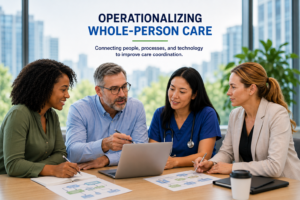

How integrated care management, improved coordination, and data-driven strategies can help healthcare organizations improve outcomes, reduce avoidable utilization, and demonstrate measurable value.
Healthcare organizations face growing pressure to improve outcomes, manage costs, and coordinate care for increasingly complex populations. For health plans, health systems, community-based networks, and other risk-bearing organizations, effective care management is essential to achieving these goals.
As value-based care arrangements expand, organizations must demonstrate not only that they are delivering services, but that those services are improving outcomes and making more efficient use of healthcare resources.
Yet measuring the return on investment (ROI) of care management programs remains challenging. Benefits may be distributed across multiple providers, organizations, and funding sources, while improvements in member health and utilization can take time to materialize.
Maximizing care management ROI requires a coordinated approach that connects clinical teams, community-based providers, and operational workflows. It also requires the ability to identify emerging risks, address medical, behavioral, and social needs, and measure the impact of interventions across the continuum of care.
The following five strategies can help healthcare organizations strengthen care management performance and demonstrate measurable value.
- Focus Resources on High-Risk and Rising-Risk Populations
Effective care management begins with identifying individuals who are most likely to benefit from coordinated intervention.
Healthcare organizations frequently serve individuals with multiple chronic conditions, behavioral health needs, functional limitations, and social challenges that affect their ability to access and maintain care.
While traditional risk identification often relies on historical utilization, a more proactive approach incorporates clinical, behavioral, and social information to recognize individuals whose needs may be escalating.
Organizations can improve resource allocation by:
- Identifying individuals with frequent emergency department visits, repeated hospitalizations, or complex chronic conditions.
- Recognizing behavioral health and social factors that contribute to gaps in care.
- Using assessments and risk stratification to prioritize interventions.
- Assigning appropriate levels of care management based on individual needs.
- Adjusting services and intervention intensity as conditions change.
For organizations operating under value-based or risk-sharing arrangements, targeting resources effectively can help reduce avoidable costs while improving outcomes.
For health systems and community-based networks, it also helps ensure that limited staff and service resources are directed toward individuals with the greatest needs.
- Strengthen Coordination Across Healthcare and Community-Based Providers
Care management programs often involve multiple organizations, including hospitals, primary care providers, behavioral health agencies, social service organizations, and community-based providers.
When these organizations operate through disconnected systems, important information can be difficult to share, creating gaps in communication, duplicative assessments, and delays in service delivery.
A coordinated approach helps care teams maintain a more complete understanding of each individual’s needs, services, and progress.
Organizations can strengthen collaboration by:
- Establishing shared care plans that support coordination across disciplines.
- Improving communication among medical, behavioral health, and community-based providers.
- Tracking referrals and service delivery across participating organizations.
- Reducing duplicate documentation and administrative processes.
- Providing appropriate visibility into care activities, outcomes, and outstanding needs.
For health plans, stronger coordination can support network performance and more effective management of complex member populations. For health systems, it can improve continuity of care between inpatient, outpatient, and community settings.
For community-based networks, it can support more consistent service delivery across participating agencies while providing greater visibility into network-wide activities.
Connecting care management and utilization management can further strengthen coordination by helping organizations identify service needs, monitor authorizations where applicable, and support timely access to appropriate care.
- Address Behavioral Health and Social Needs Through Whole-Person Care
Medical conditions are only one part of an individual’s overall health.
Behavioral health challenges, housing instability, transportation barriers, food insecurity, and other social needs can affect treatment adherence, access to services, and healthcare utilization.
For organizations serving complex populations, addressing these factors is often essential to achieving sustainable improvements in outcomes.
A whole-person approach brings medical, behavioral, functional, and social information together to support more comprehensive assessments and individualized care planning.
Effective programs should support:
- Comprehensive assessments that identify medical, behavioral, and social needs.
- Person-centered care plans developed around individual goals and preferences.
- Coordination with behavioral health and community-based service providers.
- Referral management and follow-up to confirm access to needed services.
- Ongoing monitoring and reassessment as individual needs change.
By addressing the factors that contribute to avoidable utilization and gaps in care, organizations can improve engagement, support more appropriate service delivery, and strengthen overall program effectiveness.
For community-based networks, this approach also creates opportunities to demonstrate the contribution of nonmedical services to broader healthcare outcomes.
- Improve Care Transitions and Reduce Avoidable Utilization
Transitions between hospitals, outpatient settings, behavioral health programs, long-term services, and community-based care represent important opportunities to improve both outcomes and operational efficiency.
Individuals with complex needs may require coordinated discharge planning, medication management, follow-up appointments, transportation, or ongoing support services.
Without effective communication and follow-through, these transitions can result in gaps in care, unnecessary emergency department visits, and avoidable readmissions.
Organizations can improve transitional care management by:
- Identifying individuals who need additional support following hospitalization or other care transitions.
- Coordinating discharge planning and follow-up services across providers.
- Automating notifications and task assignments for care team members.
- Tracking referrals, appointments, and outstanding service needs.
- Monitoring changes in condition that may require additional intervention.
For health plans and health systems, these activities can help reduce preventable readmissions, improve continuity of care, and manage avoidable utilization.
For community-based networks, coordinated transitions can help individuals access the services and supports needed to remain safely in their homes and communities.
When care management and utilization management workflows are connected, organizations can also gain better visibility into service utilization and opportunities for earlier intervention.
- Measure Clinical, Financial, and Operational Performance
Demonstrating care management ROI requires more than tracking the number of assessments completed, referrals made, or individuals enrolled in programs.
Organizations need to understand whether their interventions are improving outcomes, reducing unnecessary utilization, and supporting more efficient service delivery.
This can be particularly challenging when services are delivered across multiple organizations and funding arrangements.
A comprehensive measurement strategy should include:
Performance Area | Example Measures |
Clinical Outcomes | Readmissions, emergency department utilization, gaps in care |
Financial Performance | Total cost of care, avoidable utilization costs, performance under value-based contracts |
Operational Efficiency | Caseload management, assessment completion, staff productivity |
Care Coordination | Referral completion, care transitions, follow-up activities |
Member Engagement | Successful outreach, care plan participation, service access |
Organizations should also evaluate results against appropriate baselines and account for differences in population risk and program costs.
For health plans, these measures can support medical cost management, quality improvement, and performance under risk-based arrangements. For health systems participating in accountable care or other value-based arrangements, they can help demonstrate performance against financial and quality objectives.
For community-based networks, consistent reporting can help document services delivered, identify gaps across participating organizations, and demonstrate value to healthcare partners, payers, and funding organizations.
The ability to capture and report information across programs is essential to understanding which interventions are effective and where resources can be better allocated
Page Content
The Role of Integrated Technology in Improving Care Management ROI
Even well-designed care management programs can struggle to achieve consistent results when information is fragmented across systems and organizations.
Healthcare organizations need technology that supports coordinated workflows, information sharing, and visibility into care activities without adding unnecessary administrative complexity.
An integrated care management solution can help organizations:
- Maintain comprehensive member profiles that bring together medical, behavioral, and social information.
- Support configurable assessments, person-centered care plans, and service coordination.
- Automate routine workflows, assignments, notifications, and follow-up activities.
- Facilitate collaboration among interdisciplinary teams and participating organizations.
- Track referrals, services, and care transitions.
- Capture and report data needed to evaluate program effectiveness and demonstrate outcomes.
Flexibility is particularly important for organizations managing multiple programs, provider relationships, and populations with different needs.
Technology should adapt to existing care delivery models while providing the consistency and visibility needed to coordinate services and measure performance across the network.
Building Sustainable Value Through Better Care Coordination
Maximizing care management ROI is not simply about reducing healthcare spending. It is about delivering appropriate services, improving outcomes, and ensuring that clinical and community-based resources are used effectively.
For health plans, this means managing complex populations, improving quality performance, and reducing avoidable medical costs. For health systems, it means strengthening coordination across care settings and supporting performance under value-based arrangements. For community-based networks, it means improving collaboration among participating organizations and demonstrating the value of coordinated services.
InfoMC Health helps healthcare organizations achieve these goals through its integrated incedo8 platform, which supports care management, utilization management, and coordination across medical, behavioral, and community-based services.
With configurable workflows, comprehensive member information, and flexible reporting capabilities, InfoMC Health enables organizations to streamline operations, improve collaboration, and gain greater visibility into the effectiveness of their care management programs.
Learn more about InfoMC Health’s incedo8 enterprise care management solution and how integrated technology can help healthcare organizations improve coordination, manage complex populations, and demonstrate measurable value.